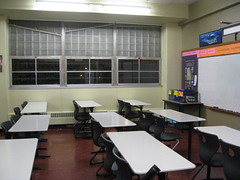
The School of One

Not good enough anymore

While researching innovative approaches to educating our children, I came across a pilot project that was run this past summer at a single school in New York City. It’s been dubbed “School of One,” and the approach is very similar to the types of things I mentioned as possibilities in “The Textbook of the Future?” To quote this New York Times article:

The program […] consists mainly of students working individually or in small groups on laptop computers to complete math lessons in the form of quizzes, games and worksheets. Each student must take a quiz at the end of each day; the results are fed into a computer program to determine whether they will move on to a new topic the next day.

[…]

Now, he added, “we’re looking in a way that I don’t think anyone has looked at — at the way children learn, pacing them at their own pace, all of it tied to the mastery of content and skill and achievement.”

[…]

Once the students arrive at school, they receive their individual playlists identifying the lessons they have to complete for the day, which could involve virtual tutoring online, computer worksheets or small-group lessons with a classroom teacher.

This is exactly the type of thing I think we should be moving toward! If done right, School of One should ensure that all students get the education they need, via the best learning style for them, and by the end of the year all of the students should have had the chance to complete all of the core curriculum along with, hopefully, some bonus activities based on their interests. One child that participated in this program actually said that the educational games he played making solving mathematical equations fun! Imagine that!
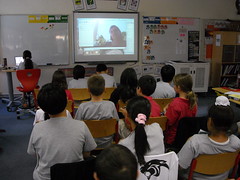
Skype in the Classroom - Better
Skype in the Classroom – Better

If you pair up my vision of the future textbook with School of One, with a little additional effort and funding I think you have a solid base for the future of education. In the article, an HR professional for the New York City school where this took place said that running schools this way should cost about the same as running a school the way it’s done now. Many detractors of moving to more technology-focused schools claim that costs would be much higher — that may not hold up after all!

In fact, many of the things that schools traditionally pay a lot of money for are available for free, as pointed out by The Innovative Educator. Chief among them – Microsoft Live@edu and Google Apps for Education. Both are completely free (as in puppies). A school using Google Apps can provide word processing, spreadsheet, website building and presentation software along with e-mail completely free to students and teachers! Just make sure the Internet connection is up and running (or install Google Gears for offline access).

I guess the chief reason for this post is to point out that things are happening despite the naysayers. School of One is exactly what I hope my son will experience when he begins school. With some luck, funding and pressure from parents, there’s a light at the end of the tunnel for those of us who believe that the continuous evolution of major systems is the only way forward.

¶¶¶¶¶

¶¶¶¶¶

3 responses to “The School of One”

  1. I’m not sure that the self-paced approach works all the time. I went to a charter school for 5th-8th grades and our math class was an at-your-own-pace worksheet based system. We had to complete a set number of worksheets a week and we could improve as we chose. Now, this worked for some students. The self-motivated soared above and beyond normal expectations. I, however, am not one of those, and I figured how to cheat the system instead. It was easier, and math worksheets bored the hell out of me. I got one worksheet to count for my 3 per week for 3 weeks in a row. I was sneaky. As a result I fell far behind in 6th and 7th grade.

    The point is not that this system is flawed, but simply that it doesnt work for everyone. In 8th grade, my parents rode me hard, and made me do twice as much work as the other kids. As a result I was caught up with even the most advanced kids by the end of the year and I went straight into Algebra 2 in high school (thereby testing out of algebra 1 because I was so far advanced in my own lessons).

    If you give every kid the personal attention he needs then it would work, but kids can get lost in the crowd in this system as easily as they can in the school system now. In high school, we used the traditional math teaching system, and I have to say I much preferred the stricter approach because it made me do my work. When there are tests and I am allowed to go ‘at my own pace’, there’s no pressure, and I don’t improve. That’s just the way I’m made.

    It might have been different if I were somehow rewarded by my achievement, as the article you quoted suggests this system would, but in my old school the only reward was more work…. and that didn’t fly with me. So I made sure I flew under the radar.

  2. […] of the disciplined Or are you just a freakish mutant? Pay equity Sandwiches just outside London The school of one Werewolves vs Plastinates You are what you […]

  3. Hey Matt,

    First, thanks for commenting. I agree that there needs to be plenty of support and you’re right to assume that the current School of One model has a lot of it. From the article: “In a program of 80 students, there are four teachers, with four graduate students from New York University working as assistants, and two high school interns who serve as tutors for students who are struggling.”

    That’s 10 support staff, some professionals and some not, for 80 students. An 8:1 ratio of students to support is phenomenal compared to my experience of 30 students to 1 teacher and the occasional student teacher!

    The achievement thing is actually being debated very hard right now – there has been such a huge sense of self-entitlement embedded into the most recent generation of children that I’d actually like to see if we can focus more on the long-term achievements that doing well in school can provide. I’ve actually seen several books promoting non rewarding children for every little thing (i.e. “graduating” from Kindergarten) and I’m a fan of that. I’m not opposed to small, school-based rewards for achievement within the school system but that’s about it.

Leave a Reply